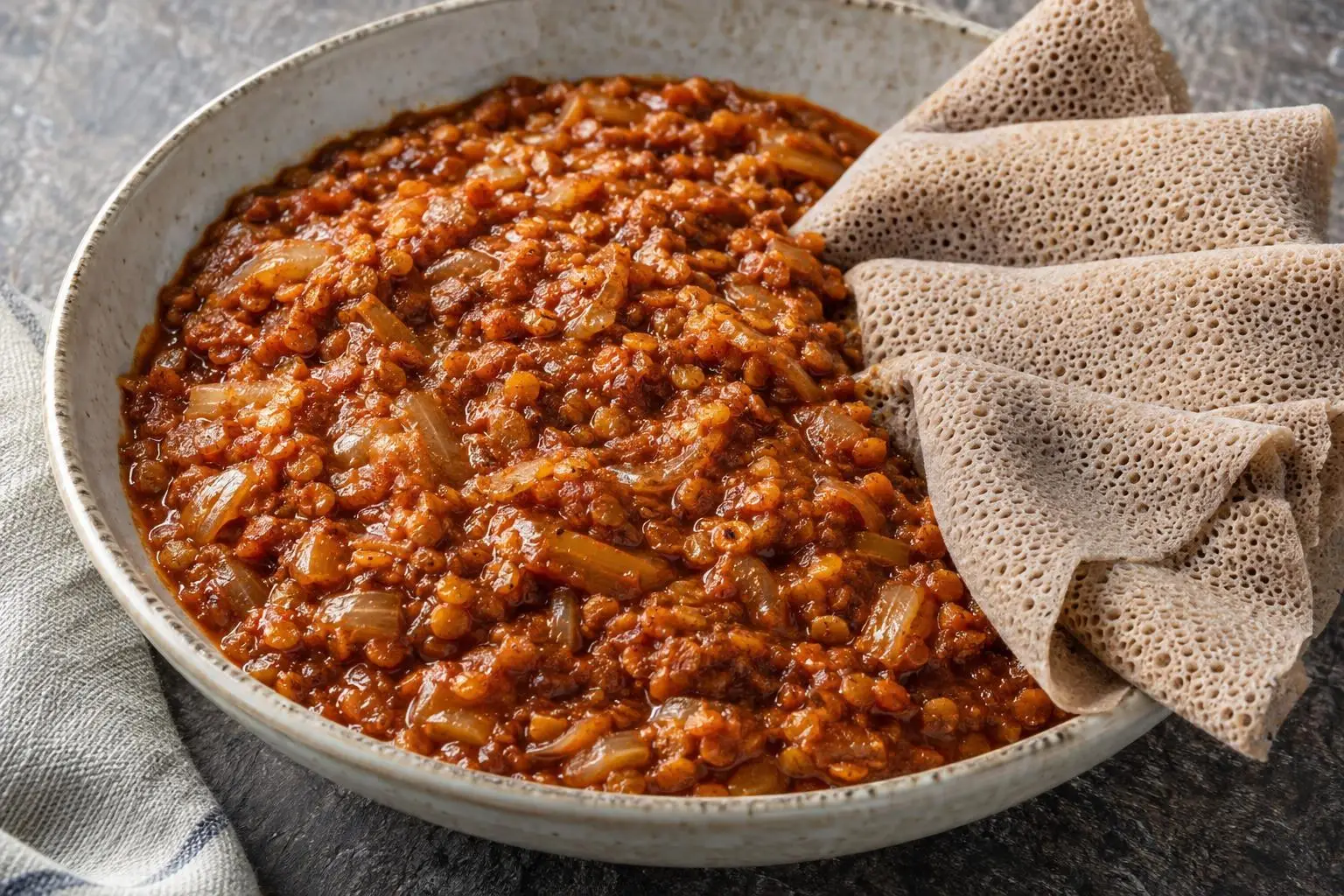
Misir wat with slow-cooked onions
An Ethiopian red lentil stew with sweet, thoroughly softened onions, warm berbere heat and a thick, spoonable texture, served with injera. Allow about 1 hour 25 minutes, or longer if the onions or lentils need more cooking.
Advert
Let’s get cooking.
Cook mode
Scale servings, tick off ingredients, and run step timers without losing your place.
Servings
Originally developed for 4 servings.
Ingredient checklist
Method
- No timer needed
Finely chop the onions into 3–5 mm pieces. Grate or crush the garlic and grate the ginger. Pick over the lentils and rinse in a sieve until the water runs mostly clear. Measure the remaining ingredients and check the injera packet's warming instructions. Allow about 12 minutes for preparation.
- 05:00
Put the onions in the saucepan over medium-low heat, without oil, and cover. Cook for 5 minutes to release moisture, then uncover and cook for another 20–25 minutes, stirring every 1–2 minutes. They should become very soft, reduced and pale golden, not deeply browned. If they catch, lower the heat and add water from the additional 200 ml allowance, about 15 ml at a time, using up to 50 ml here. Reserve the remainder for the lentils and finishing. Extend cooking if the onions are still firm; discard and restart if they become blackened and bitter.
- No timer needed
Fill and switch on the kettle for the 750 ml cooking water, plus the remaining additional water. While it boils, stir the oil, garlic and ginger into the softened onions. Cook over medium-low heat for 3 minutes, stirring, until fragrant and the raw garlic smell fades.
- No timer needed
Add the berbere and 50 ml freshly boiled water. Cook for 2 minutes, stirring continuously, until fragrant and paste-like. Keep the paste moist at a gentle sizzle; it must not dry onto the base or blacken. Lower the heat and add a small splash of the reserved additional water if it starts sticking.
- No timer needed
Stir in the rinsed lentils, 700 ml hot water and 3 g salt, or just 1 g if your berbere contains salt. Keep the final 1 g salt for finishing. Bring to a gentle boil, allowing about 3 minutes after adding the ingredients and stirring across the base as needed.
- 25:00
Reduce to a gentle, uncovered simmer and cook for about 25 minutes. Stir every 3–4 minutes initially, then every 1–2 minutes as it thickens, scraping the whole base. Add reserved hot water in 25–50 ml portions if it becomes stiff before the lentils soften. At 25 minutes, check that the lentils crush easily with no chalky centre and have mostly collapsed into a thick sauce. Continue simmering with more hot water if necessary; older lentils can take longer. Avoid vigorous boiling, which can make the thick stew splash.
- 05:00
Taste and add the reserved salt a pinch at a time, only as needed. The stew should spread slowly from a spoon. If watery, simmer uncovered for another 3–8 minutes, stirring frequently; if stiff, add a little reserved hot water. Remove from the heat and rest for 5 minutes. Meanwhile, warm the injera according to its packet. If microwave-suitable injera has no specific warming directions, place two folded injera on a covered microwave-safe plate and heat for about 1 minute at 800 W, until soft and warm. Keep covered while repeating with the remaining two.
- No timer needed
While the stew finishes resting, set out four shallow bowls and keep the warmed injera covered. Check the rested stew and loosen with a splash of reserved hot water if needed. Divide between the bowls and serve with the injera for scooping.
Chef tips
- The baseline schedule assumes the onions soften and the lentils become tender at the stated checks. Extra softening, simmering or reduction will extend it; do not increase the heat simply to meet the estimate.
- Keep the spice paste moist and stir continuously. Blackened berbere tastes bitter and cannot be corrected by adding water.
- If the lentils remain chalky, add hot water and continue simmering before reducing the stew to its final thickness.
- The stew thickens as it rests. Reduce a loose stew only after the lentils are tender, and loosen a stiff stew with small splashes of hot water.
- Start conservatively with unfamiliar berbere. Water alone will not reliably correct excessive heat without making the stew too thin.
- The injera schedule allows two one-minute microwave batches. Follow packet directions if they differ, allowing additional time where needed.
Equipment check
- Heavy-based saucepan or casserole, approximately 3 litres and 20–22 cm wide, with lid
- Wooden spoon or heatproof spatula
- Fine sieve
- Kitchen scales and measuring jug
- Chopping board and sharp knife
- Fine grater or garlic press
- Kettle
- Microwave and microwave-safe plate with cover
Tags
Behind the dish.
Overview
This misir wat should spread slowly when spooned onto injera rather than run like soup. Cooking finely chopped onions before adding oil builds a sweet foundation; cooking the berbere briefly as a moist paste develops its flavour without scorching it. The lentils mostly collapse, retaining a little texture. Allow longer if the onions have not softened or the lentils still have a chalky centre.
Ingredient notes
Use split red lentils, not whole lentils. Berbere varies considerably in heat and salt: use 15 g of a moderately hot blend, 10 g for an unfamiliar chilli-heavy blend, or up to 20 g for a known mild blend. Use an Ethiopian-style blend rather than generic curry powder. The salt quantities assume unsalted berbere; reduce the initial salt if your blend contains salt.
Ready-made injera is the explicit shortcut; fermenting and cooking homemade injera is not included. Choose microwave-suitable injera for the warming method below. Check injera and berbere labels for allergens and animal-derived ingredients. Commercial injera may contain wheat or barley, so this meal is not necessarily gluten-free. The vegan designation assumes both purchased products are suitable.
Serving & storage
Serve in four shallow bowls with warm injera for scooping. Cool leftover stew promptly in shallow portions and refrigerate within 2 hours at 5°C or colder. Use within 48 hours or freeze sooner. Thaw frozen portions in the fridge and reheat only once until steaming hot throughout, stirring in a little water as needed. Store injera according to its packet instructions.
Related recipes
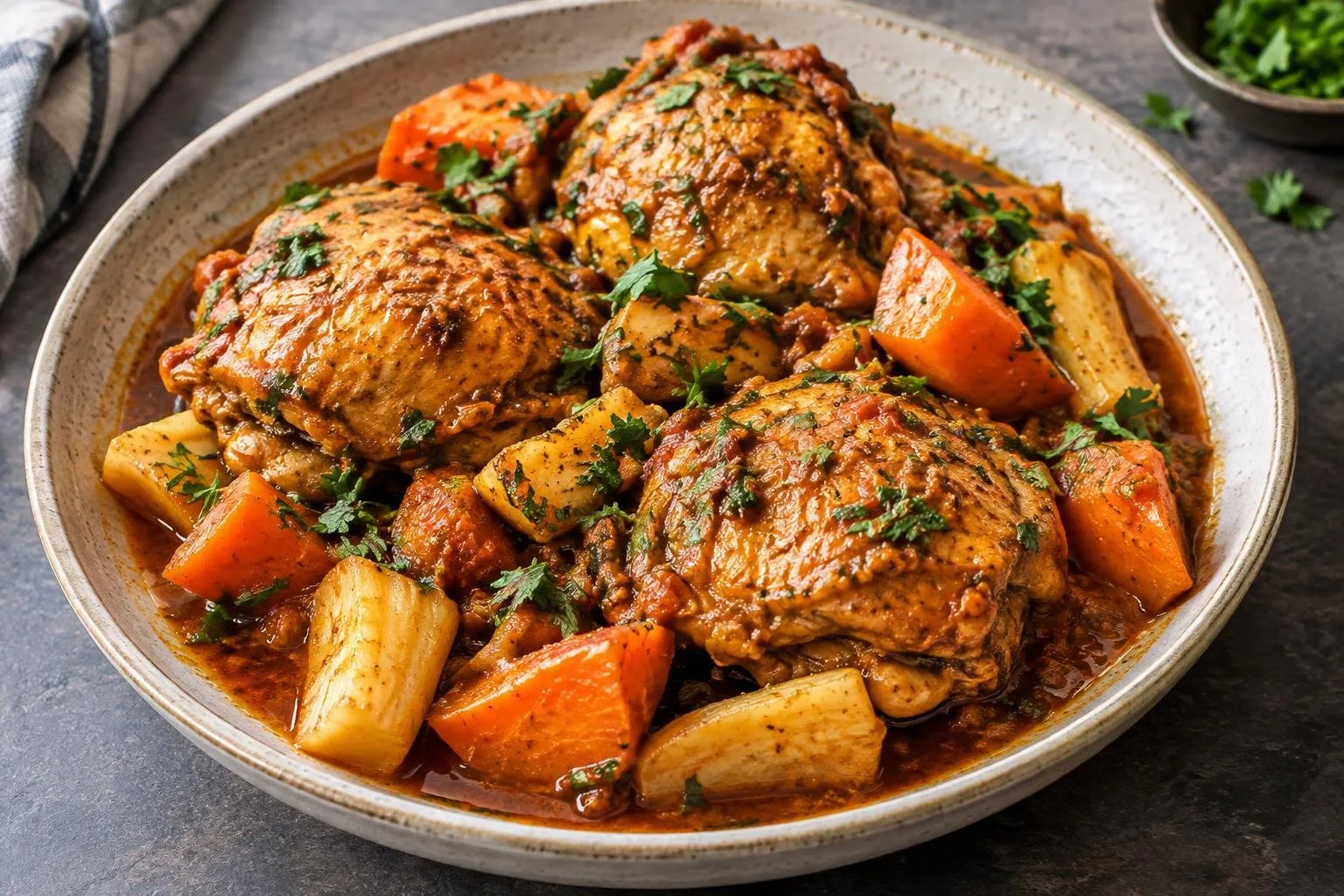
Ethiopian Doro Wat-Inspired Poached Chicken Stew
◷ 80 minmedium
A comforting and flavorful Ethiopian-inspired poached chicken stew featuring seasonal root vegetables and traditional spices, gently simmered to tender perfection. This recipe highlights poaching as a gentle cooking method, celebrating an authentic stew that honors Ethiopian culinary traditions while using accessible ingredients.
Jan 31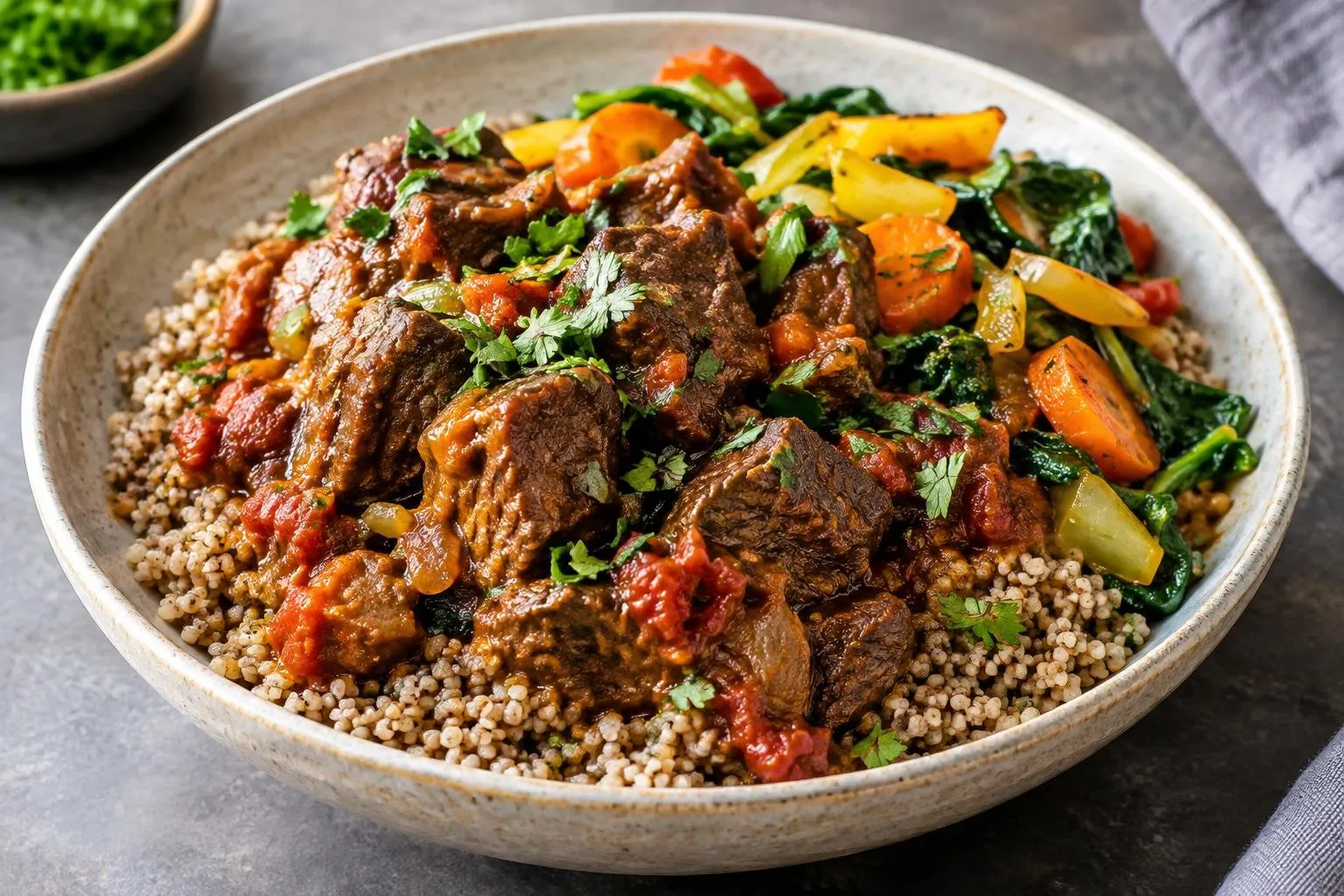
Ethiopian-Inspired Slow Braised Beef Tibs Grain Bowl
◷ 200 minmedium
This hearty grain bowl features slow braised Ethiopian-style beef tibs infused with traditional spices, served over a bed of fluffy injera-inspired teff grains and topped with sautéed seasonal vegetables. It embraces slow braising as a comforting cooking method and highlights Ethiopian flavors without fusion elements, making it perfect for a wholesome weeknight meal.
Jan 29
Ethiopian-Inspired Stir-Fried Chicken with Seasonal Vegetables
◷ 30 mineasy
A vibrant and flavorful stir-fry featuring tender chicken pieces quickly cooked with a medley of fresh, seasonal vegetables, inspired by traditional Ethiopian spices and flavors. This recipe offers a quick weeknight meal that showcases the rich spice heritage of Ethiopian cuisine while embracing the convenience of stir-frying.
Jan 28