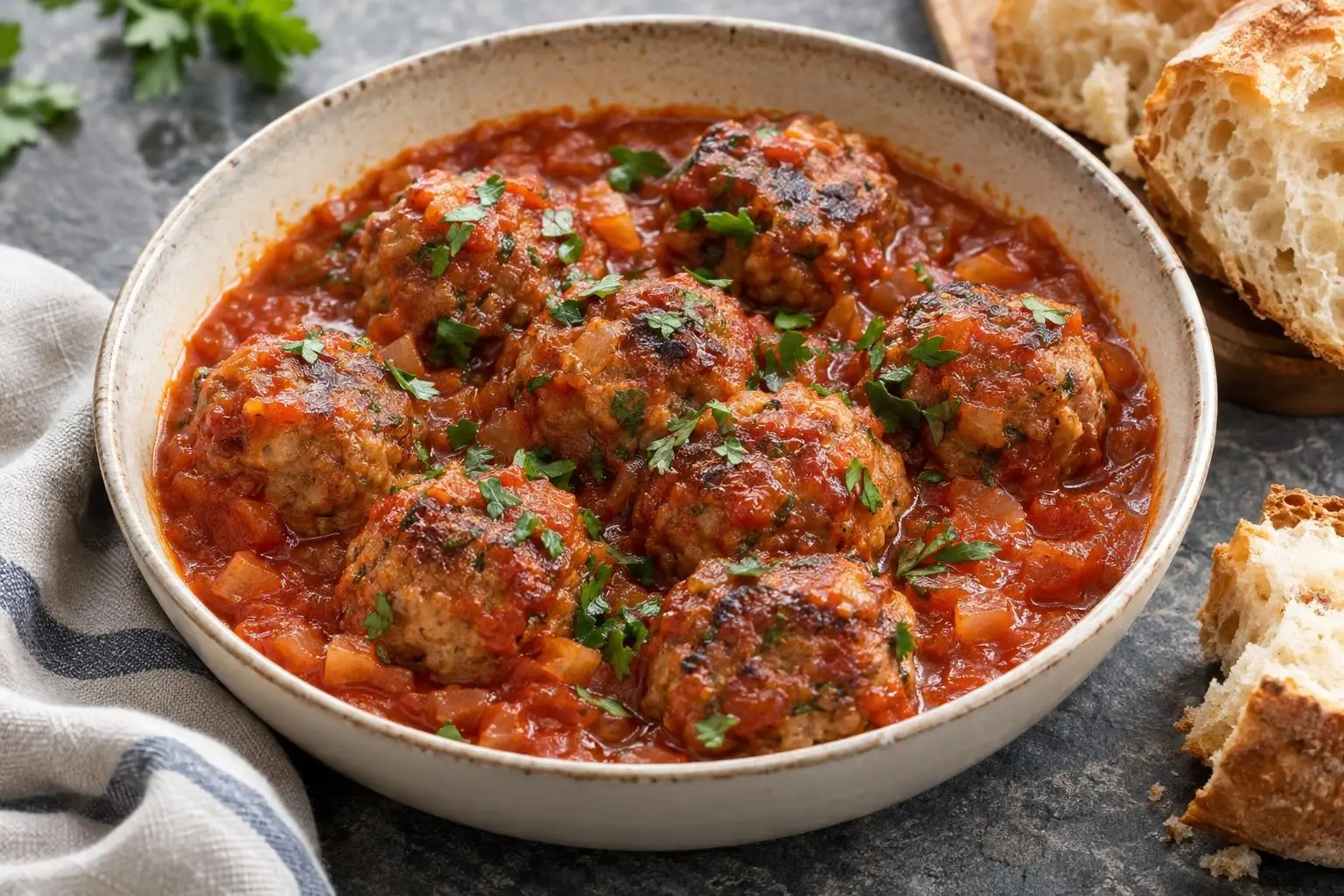
Pan-browned Albóndigas in Tomato Sauce
Tender Spanish beef-and-pork meatballs, pan-browned and gently finished in a thick, spoonable tomato sauce, served with crusty bread. Allow about 1 hour 20 minutes, plus additional simmering and temperature checks if needed.
Advert
Let’s get cooking.
Cook mode
Scale servings, tick off ingredients, and run step timers without losing your place.
Servings
Originally developed for 4 servings.
Ingredient checklist
Method
- 05:00
Tear the soft bread into a mixing bowl, add the milk and soak for at least 5 minutes, until no dry pieces remain. Meanwhile, dice the onion, prepare the garlic and chop the parsley. Set aside 8 g grated garlic and 10 g parsley for the meatballs, 4 g chopped garlic for the sauce and 5 g parsley for garnishing. Keep the garnish away from the raw-meat work area.
- 08:00
Heat 10 ml olive oil in the deep sauté pan over medium-low heat. Add the onion and 2 g salt; cook for 8–10 minutes, stirring occasionally, until soft and translucent rather than browned. Check after 8 minutes. Add the 4 g chopped garlic and cook for 1 minute.
- No timer needed
Stir in the passata, 100 ml water and ¼ tsp pepper. Bring to a gentle simmer, then lower the heat. Simmer uncovered while you mix and shape the meatballs, stirring around the edges when shaping is finished. After roughly 15 minutes, check the consistency, partially cover and keep at a very low simmer while browning the meatballs. If the sauce catches or becomes paste-like, stir in water in 30–50 ml additions; it must remain loose enough to flow around the meatballs.
- No timer needed
While the sauce comes to a simmer, mash the soaked bread and all its milk into a paste. Mix in the egg, 8 g grated garlic, 10 g parsley, 4 g salt and ¼ tsp pepper. Add both minces and mix just until evenly combined, without kneading. Briefly lower the sauce heat when it reaches a simmer, then divide the meat mixture into 20 portions of about 35 g. Roll gently with damp hands into balls about 4 cm across. Wash your hands and clean raw-meat utensils and surfaces before handling ready-to-eat food.
- 07:00
Heat the remaining 20 ml olive oil in the frying pan over medium-high heat. Brown the meatballs in two batches of 10, leaving gaps between them, for 6–8 minutes per batch. Let a crust form before gently turning to colour two or three sides. Lower the heat if the garlic or pan residue begins to burn. Transfer each batch straight into the hot sauce with a spoon or spatula; do not pour in the frying fat. The centres are not yet cooked through, so continue directly to the finishing simmer.
- No timer needed
Once the final batch is added, arrange the meatballs in one layer and spoon sauce around them. Add a little extra water if needed, partially cover and return to a gentle simmer. From when the simmer resumes, cook for 15–20 minutes, gently turning the meatballs once about halfway through and stirring the sauce around them. Avoid a rolling boil, which can toughen or break them.
- No timer needed
After 15 minutes, check three of the largest meatballs from different parts of the pan, one at a time, with a clean thermometer. Probe the centre without touching the pan: each must reach 75°C and remain at or above it for 30 seconds. Allow about 3 minutes for sequential checks, probe stabilisation and the full holds; clean the probe between checks. The meatballs should also feel set but remain tender. If any is below the endpoint, simmer for another 3–5 minutes, then repeat the checks with a cleaned probe. Once safely cooked, uncover and simmer for about 3 minutes if needed to thicken the sauce: it should coat a spoon but still pool around the meatballs. Taste and adjust the salt if needed. Only if the sauce remains sharply acidic, stir in the optional ½ tsp sugar.
- No timer needed
Scatter over the reserved 5 g parsley. Serve five meatballs per person with equal portions of sauce and the crusty bread. Use clean serving utensils, not unwashed utensils that handled raw or partially cooked meat.
Chef tips
- Mash the soaked bread thoroughly, mix only until combined and roll without compressing to avoid dense meatballs.
- If the mixture is unusually soft, refrigerate it for 15 minutes before shaping; this adds waiting time. Avoid adding lots of dry breadcrumbs, which can make the meatballs dense.
- If a meatball sticks during browning, let its crust develop a little longer and release it with a thin spatula rather than pulling it apart with tongs.
- Keep the finishing simmer gentle. If the sauce catches or thickens too much before the centres are cooked, add water in 30–50 ml increments.
- If the sauce remains watery once the meatballs are safely cooked, lift them into a clean bowl, reduce the sauce uncovered, then return them.
- The schedule allows three minutes for the first set of temperature checks and assumes they pass. Further simmering and repeat checks extend the serving time; do not serve until the specified endpoint is met.
Equipment check
- 28–30 cm deep sauté pan with lid, approximately 3 litres, with a base large enough for 20 meatballs in one layer
- 26–28 cm frying pan
- Two hob rings
- Mixing bowl
- Digital scales and measuring jug
- Knife, chopping board and fine grater
- Flexible spatula and spoon or tongs
- Digital food thermometer
- Clean serving bowls and utensils
Tags
Behind the dish.
Overview
These albóndigas have tender, moist centres, lightly browned surfaces and a tomato sauce that pools around them. Milk-soaked bread and minimal mixing keep the meatballs tender; uncrowded batch browning builds flavour, and a gentle simmer finishes the centres. Makes 20 meatballs, serving four with bread. You need two hob rings and two pans; no oven is required.
Ingredient notes
Choose beef mince with about 15% fat and pork mince with about 10–20% fat. All-beef mince can replace the pork at the same weight; use 15–20% fat rather than very lean mince. Use soft bread for the binding mixture: 50 g of dry breadcrumbs is not an equivalent substitute. Plain passata varies in thickness, so adjust the sauce with water as needed.
Contains milk, egg and wheat/gluten. Check both breads for additional allergens, including sesame or soya, and check labels on substitutions.
Serving & storage
Serve five meatballs per person with equal portions of sauce, parsley and crusty bread. Divide leftovers into shallow containers, cool promptly and refrigerate within 2 hours at 5°C or colder. Use within 48 hours or freeze sooner. Thaw in the fridge and reheat only once until steaming hot throughout, turning the meatballs and stirring the sauce for even heating. Add a little water if the sauce has thickened.
Related recipes
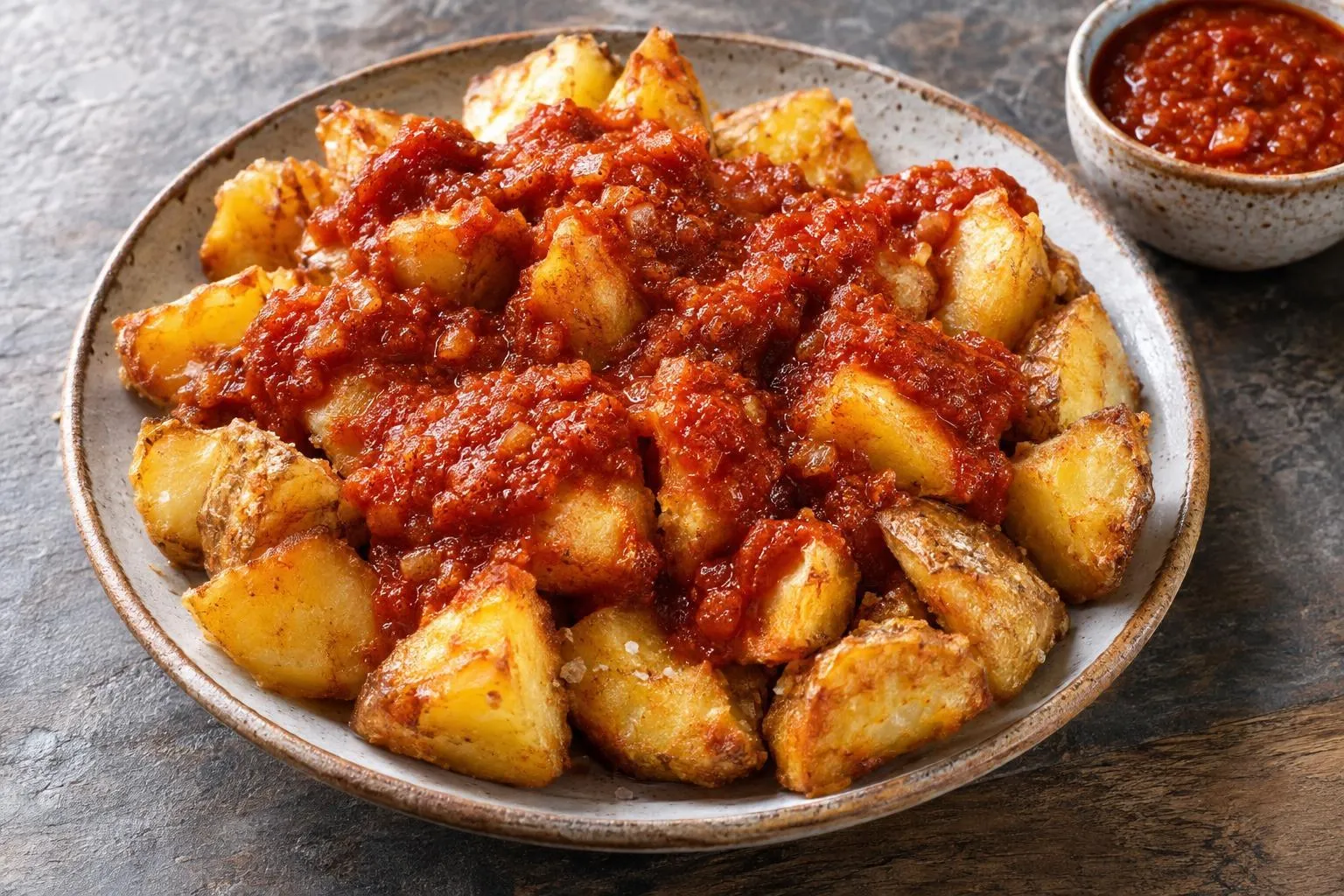
Patatas bravas with spicy tomato sauce
◷ 75 minmedium
Golden, shallow-fried potato chunks with fluffy centres and a thick tomato sauce sharpened with sherry vinegar, garlic, smoked paprika and cayenne. Makes four tapas or side portions; allow about 75 minutes.
Oct 15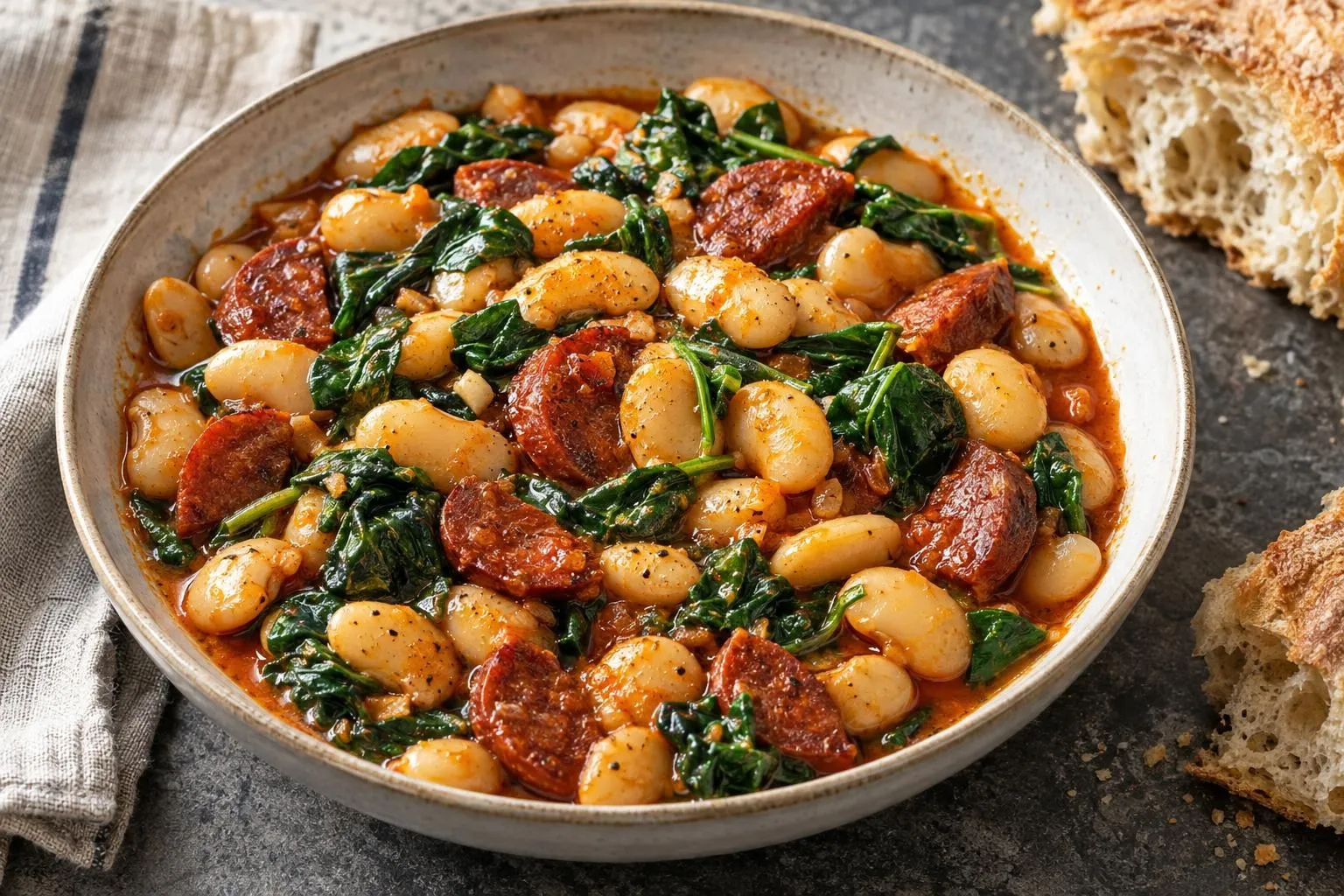
Smoky butter beans with chorizo and spinach
◷ 30 mineasy
Render cured Spanish chorizo, then simmer butter beans in its paprika-rich oil for a glossy, lightly thickened sauce. Tender spinach and a splash of sherry vinegar balance the creamy beans and smoky, savoury chorizo.
Oct 9
Tortilla española with onion
◷ 65 minmedium
Potatoes and onion gently cooked in olive oil, folded into eggs, then pan-cooked and flipped into a golden tortilla with a tender, fully set centre. Allow about 65 minutes, including resting; serve warm or at room temperature.
Oct 3